

Table of Contents
- Driveway Cleaning Lifespan: What to Expect
- How Long Does Driveway Cleaning Last by Surface Type?
- Environmental Factors That Shorten Your Results
- The Best Way to Remove Oil Stains for Longer-Lasting Results
- Chemical vs. Mechanical Cleaning: Which Lasts Longer?
- Mechanical Cleaning: What It Removes and What It Misses
- Chemical Cleaning: The Mechanism of Extended Results
- The Trade-Offs: Skill, Safety, and Equipment
- The Hybrid Approach: What Most Professionals Actually Do
- Why DIY Pressure Washing Fails to Match Professional Longevity
- The Bottom Line on Method Selection
- Benefits of Driveway Sealing After Cleaning
- How Often Should You Pressure Wash Your Driveway?
- Maintenance Schedule to Extend Cleaning Results
- Frequently Asked Questions
Last Updated: September 9, 2026
Driveway Cleaning Lifespan: What to Expect
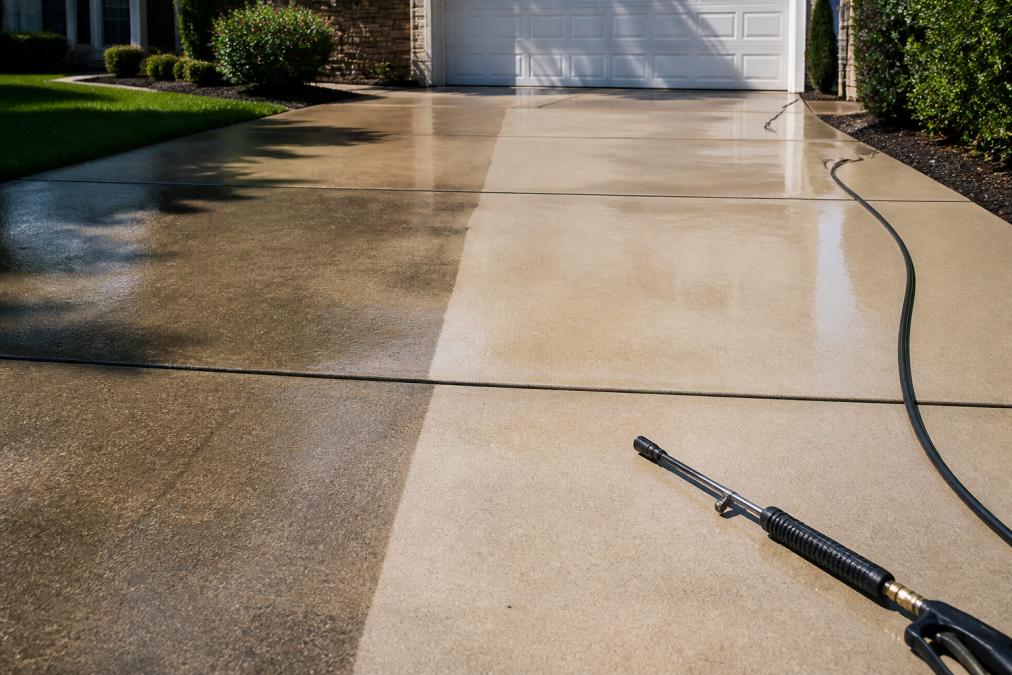
Ask ten contractors “how long does driveway cleaning last” and you will hear ten different answers, because most confuse two questions: how long the cleaning takes, and how long the results hold up. Driveway cleaning results typically last between six months and two years, determined by surface material, local climate, and whether you seal afterward (cleanfax.com).
The biggest factor is surface type, covered below, with shade, tree cover, and rainfall a close second. Most disappointed homeowners skipped sealing or used a DIY approach that missed organic matter taking root in the pores.
How Long Does Driveway Cleaning Last by Surface Type?
Concrete, asphalt, and paver surfaces each absorb and shed contaminants differently, which changes how often you need to schedule exterior maintenance.
Concrete Driveways
Concrete is the most common and most porous driveway material. Because water and organic matter seep below the surface, results on unsealed concrete fade fastest, often within six to twelve months in damp or shaded conditions. Concrete responds well to a surface cleaner attachment plus a biocide treatment, which kills algae at the root rather than blasting away visible grime.
Asphalt Driveways
Asphalt lasts longer between cleanings than concrete, typically twelve to eighteen months, because its darker surface absorbs more heat and dries faster after rain. UV degradation and oil drips are the main enemies here. Asphalt also needs a gentler approach: high psi can scar the surface, so a soft wash or lower-pressure rinse with a degreaser is the safer route for driveway longevity.
Paver and Brick Driveways
Paver driveways sit somewhere in the middle, with results lasting roughly nine to fifteen months. The real challenge is paver joints. When sand stabilization fails, weeds and ant colonies move in, and cleaning alone will not fix the problem. A proper paver job includes re-sanding the joints after cleaning to lock the pavers in place and prevent re-soiling.
| Surface Type | Typical Result Lifespan | Primary Threat | Best Cleaning Approach |
|---|---|---|---|
| Concrete | 6-12 months | Algae and embedded organic matter | Pressure washing plus biocide |
| Asphalt | 12-18 months | Oil stains and UV damage | Soft wash with degreaser |
| Paver and Brick | 9-15 months | Weed growth in joints | Cleaning plus sand stabilization |
Environmental Factors That Shorten Your Results
Climate is the silent killer of a good driveway cleaning. Organic matter needs moisture, shade, and surface temperatures above freezing to recolonize. Breaking down how specific environmental forces act on your driveway lets you predict re-soiling rates far more accurately than a one-size-fits-all range.
Rainfall and Humidity: The Primary Drivers
Rainfall is the most reliable predictor of how fast algae and mold return. In regions receiving more than 45 inches of rain annually, common in the Southeast and Pacific Northwest, the surface rarely dries completely between storms, and visible re-soiling typically appears within 4 to 6 months, even with proper biocide application (the EPA). Areas under 20 inches per year, such as the Desert Southwest, can stretch results to 18 or even 24 months.
Humidity compounds the effect. Relative humidity above 70% keeps the surface film damp even without direct rain, which is why Gulf Coast driveways require more frequent attention than those in the arid interior West.
Shade and Solar Exposure: The UV Factor
Direct sunlight is a natural disinfectant. Ultraviolet radiation breaks down chlorophyll in algae and kills mold spores. A driveway receiving 6 or more hours of direct sun per day resists regrowth far longer than one on the north side of a house or under a dense canopy.
To quantify this, track the shadow pattern across your driveway during the summer solstice. If more than half the surface is shaded by 10 a.m., expect cleaning lifespan to be cut by roughly 40%, with shaded zones re-soiling unevenly.
Temperature Extremes: Freeze-Thaw and Heat Stress
In colder regions, freeze-thaw cycles stress the driveway surface. Water seeping into micro-cracks expands when frozen, widening cracks and creating new pathways for organic matter. This is why Upper Midwest and Northeast driveways often show re-soiling along crack lines within months of a cleaning.
Sustained heat above 95°F accelerates oxidation of asphalt binders, causing the surface to fade and become more porous. A porous asphalt surface absorbs oil and organic matter more readily, shortening the effective lifespan of a cleaning.
Micro-Climates Around Your Home
Beyond regional climate, your immediate surroundings create micro-climates that can override the broader forecast. A gutter downspout discharging directly onto the driveway creates a perpetually damp zone that re-soils within weeks, as do sprinkler heads that overshoot the lawn.
A simple diagnostic test: after rain, note which sections remain wet the longest, those zones will fail first. Correcting water flow, extending downspouts, adjusting sprinkler heads, or regrading low spots, is often more effective than any chemical treatment.
Regional Maintenance Intervals: A Practical Guide
Based on these mechanisms, here is a practical starting point for cleaning frequency by climate profile:
| Climate Profile | Typical Region | Expected Lifespan | Recommended Interval |
|---|---|---|---|
| High rainfall, high humidity | Pacific Northwest, Gulf Coast | 4-6 months | Twice yearly, plus spot treatment |
| Cold winter, freeze-thaw cycles | Upper Midwest, Northeast | 6-9 months | Annual cleaning, crack repair before winter |
| Moderate rainfall, distinct seasons | Mid-Atlantic, Ohio Valley | 9-12 months | Annual cleaning |
| Hot, dry, intense UV | Desert Southwest, Interior California | 18-24 months | Every 18 months, focus on oil stains |
| Arid but mild | High Plains, Intermountain West | 12-18 months | Annual cleaning |
These intervals assume a proper biocide treatment and no sealing. Adding a sealant extends each interval by roughly 50%, but only if the sealant is maintained and reapplied on schedule.
The most effective way to extend cleaning results is not to clean more often, but to eliminate the micro-climates that accelerate re-soiling. Fix the downspout, trim the shade tree, and adjust the sprinkler before you schedule your next cleaning.
The Best Way to Remove Oil Stains for Longer-Lasting Results
Oil stains are the exception to every rule about cleaning longevity. A standard pressure wash removes surface dirt but will not lift oil that has soaked into the concrete. Skip this step and the stain bleeds back within weeks.
The best way to remove oil stains is to treat them before the full driveway wash. Apply a commercial degreaser or concrete poultice, let it sit for the time specified on the label to draw oil out of the pores, agitate with a stiff brush, then rinse with hot water if available. Stubborn, years-old stains may need two or three applications.
Skipping the degreaser step on oil-stained concrete is the most common DIY mistake. The pressure washer pushes water into the pores and can actually drive the oil deeper, making the stain harder to remove later and guaranteeing it reappears quickly.
Chemical vs. Mechanical Cleaning: Which Lasts Longer?
The distinction between chemical and mechanical cleaning is the single largest determinant of how long results last. A properly applied chemical treatment will outlast a purely mechanical wash by 3 to 6 months on the same surface.
Mechanical Cleaning: What It Removes and What It Misses
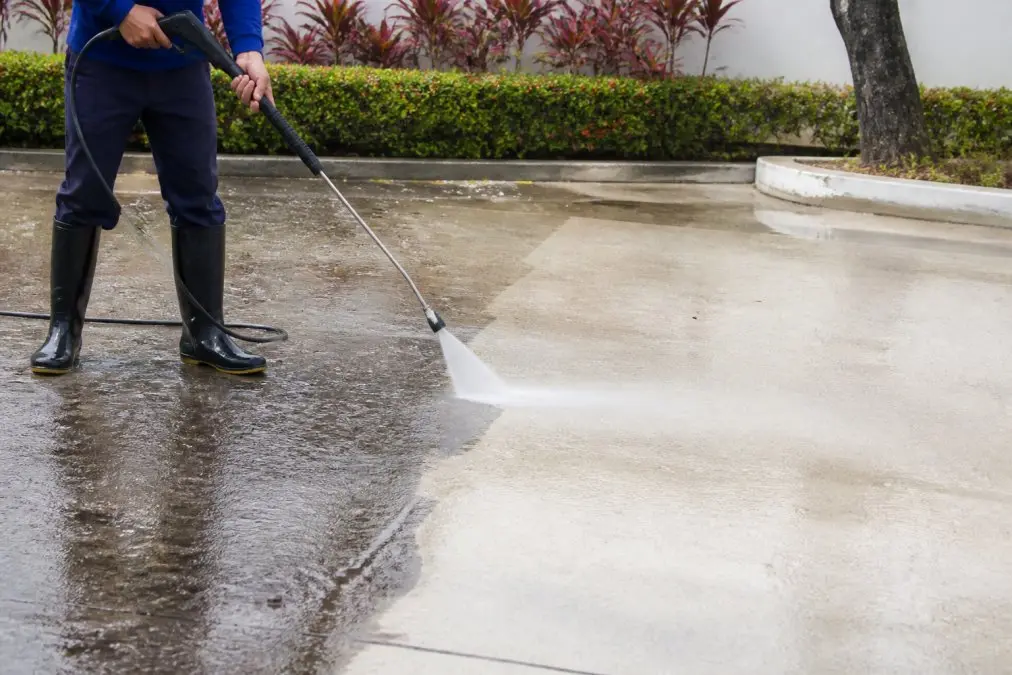
Mechanical cleaning relies on high-pressure water to physically dislodge dirt, grime, and surface growth. A pressure washer at 3,000 to 4,000 psi can strip visible algae, mold, and embedded dirt from the top layer. The problem is what it leaves behind.
Algae and mold anchor themselves into the microscopic pores and fissures of the driveway material. A pressure washer blasts away visible growth but leaves the root structure, mycelium for mold, holdfasts for algae, intact. Given moisture and shade, regrowth emerges within 2 to 4 weeks.
Mechanical cleaning also has a hidden downside: it can drive contaminants deeper. High-pressure water hitting an oil stain or organic-filled pore can push material further into the substrate, particularly on concrete.
Chemical Cleaning: The Mechanism of Extended Results
Chemical cleaning, often marketed as soft washing, uses low pressure (typically under 500 psi) with a chemical solution designed to kill organic matter at the root. The most common active ingredient is sodium hypochlorite, the same compound in household bleach but at a professional concentration of 1% to 2%.
The kill is what extends lifespan. Dead organic matter does not regrow. Once the biocide penetrates the pores and neutralizes the root structure, the surface remains biologically inert until new spores land and find favorable conditions.
Quaternary ammonium compounds (quats) are also used for soft washing. Quats are less aggressive than sodium hypochlorite and safer for surrounding vegetation, but less effective on established growth. Most professionals use quats for maintenance washes, not initial deep cleans.
The Trade-Offs: Skill, Safety, and Equipment
Mechanical cleaning remains popular for its simplicity. A pressure washer is straightforward, requires no chemical handling, and poses minimal risk to surrounding plants if used carefully. Chemical cleaning demands more skill: the solution must be mixed to the correct concentration, applied evenly, and allowed to dwell 10 to 15 minutes before rinsing.
Overspray is the primary safety concern. Sodium hypochlorite will damage landscaping, stain siding, and harm pets if not managed properly. Professional applicators use low-pressure nozzles and shield sensitive areas. Homeowners attempting a chemical wash should review the Consumer guidance on safe cleaning product use and test the solution on an inconspicuous area first.
The Hybrid Approach: What Most Professionals Actually Do
In practice, most professional driveway cleaning jobs are not purely chemical or purely mechanical. The effective sequence is:
- Pre-treatment: Apply a degreaser to oil-stained areas and let it dwell.
- Biocide application: Apply the sodium hypochlorite solution at low pressure over the entire surface.
- Dwell time: Allow 10 to 15 minutes for the chemical to kill organic matter.
- Rinse: Use a pressure washer at moderate pressure (1,500 to 2,500 psi) to rinse away the dead organic matter and any remaining chemical residue.
This hybrid approach combines the killing power of the biocide with the physical removal capability of the pressure washer, producing a surface that is both biologically inert and visually clean.
Why DIY Pressure Washing Fails to Match Professional Longevity
The most common DIY mistake is renting a pressure washer and blasting the driveway without chemical pre-treatment. This produces immediate visual improvement but fails to address the root cause. Within weeks, the algae returns, and the homeowner concludes that driveway cleaning ‘does not last.’
A second DIY mistake is using household bleach at full strength. Laundry bleach is typically 5% to 6% sodium hypochlorite, too strong for driveway application and capable of etching concrete and killing surrounding vegetation.
Never mix sodium hypochlorite with ammonia or acidic cleaners. The reaction produces toxic chlorine gas. Always apply the biocide alone, and rinse thoroughly before using any other cleaning product on the same surface.
The Bottom Line on Method Selection
If you want results that last beyond a few weeks, chemical treatment is not optional, it is the active ingredient in longevity. Mechanical pressure washing alone is a cosmetic fix. When hiring a professional, ask specifically whether they apply a biocide. If the answer is no, you are paying for a temporary cosmetic improvement.
Benefits of Driveway Sealing After Cleaning
If you want to double the lifespan of your driveway cleaning, sealing is the answer. A quality concrete or asphalt sealant acts as a barrier that keeps water, oil, and organic matter on the surface where they can be rinsed away by rain or a quick hose-down.
The process adds one critical step: curing time. A fresh sealant needs 24 to 48 hours of dry, traffic-free conditions to bond properly. Applied correctly, a sealant creates a hydrophobic surface that sheds water and resists algae growth, extending results to the full two-year mark in most climates. Budget for resealing every two to three years.
Apply the sealant only after the concrete has fully dried for at least 24 hours post-cleaning. Sealing a damp driveway traps moisture and causes the sealant to bubble and fail within months. Check for dryness by taping a square of plastic sheeting to the surface overnight; if condensation forms underneath, it is not ready.
How Often Should You Pressure Wash Your Driveway?
The answer to how often should you pressure wash your driveway depends on the same factors that determine lifespan. For the average home in a moderate climate, annual cleaning is sufficient. In shaded, damp, or tree-heavy yards, plan on cleaning every six to nine months. In hot, dry climates, you may only need service every eighteen months to two years.
Watch for warning signs that cleaning is due: darkening of the surface, slick patches where algae has formed, or visible staining near where cars park. Waiting too long allows contaminants to penetrate deeper, making the eventual cleaning harder and shortening the lifespan of results.
Maintenance Schedule to Extend Cleaning Results
Between professional cleanings, a few simple habits will stretch your results considerably. The goal is to prevent organic matter from establishing a foothold, not to remove it after it has taken hold.
- Monthly: Hose down high-traffic areas and sweep away leaves and debris that trap moisture against the surface.
- Quarterly: Spot-treat any new oil drips with a degreaser immediately. Fresh oil lifts easily; dried oil requires multiple treatments.
- Twice yearly: Trim overhanging branches and clear gutters to reduce shade and water runoff onto the driveway.
- Annually: Inspect for cracks and efflorescence (the white mineral deposit on concrete). Address cracks promptly to prevent water intrusion and freeze-thaw damage.
Following this schedule, combined with professional cleaning and sealing every one to two years, is the most reliable way to protect your driveway and maintain curb appeal. Carters Precision Pressure Washing uses commercial-grade surface cleaners and appropriate biocides to deliver results that enhance your property’s curb appeal, and we offer a free estimate.
Driveway cleaning results do not have to be a two-week wonder. The difference between a cleaning that fades quickly and one that lasts comes down to surface preparation, the right chemical treatment, and the discipline to seal afterward. At Carters Precision Pressure Washing, we specialize in restoring driveways and exterior surfaces so they stay clean longer. Call today for a free estimate.
Frequently Asked Questions
How long does a professional driveway cleaning last?
A professional driveway cleaning typically lasts between 6 to 12 months for the visual results. This lifespan depends heavily on your surface type, local climate, and whether a sealant is applied after cleaning. In shaded, damp areas, algae and mold can return faster. Sealing your driveway after a professional clean is the most effective way to push results toward the 12-month mark or beyond.
Is driveway pressure washing worth it?
Yes, especially if you are preparing your home for sale or notice slippery mold and grime. Professional pressure washing restores curb appeal and removes organic matter like algae and oil that DIY methods often miss. Professionals use the correct PSI and cleaning agents for your specific surface.
Does sealing a driveway after cleaning make the results last longer?
Yes. Sealing after cleaning creates a hydrophobic barrier that repels water, oil, and organic matter. This slows down algae growth and makes future stains easier to remove. A sealed driveway can stay cleaner for up to twice as long as an unsealed one. It also protects the surface from UV degradation and freeze-thaw damage, extending the life of the concrete or asphalt itself.