
Table of Contents
- Step 1: Assess Substrates and Set Safety Boundaries
- Step 2: Choose Your Method: Soft Washing vs Pressure Washing for Commercial Buildings
- Step 3: Select Cleaning Agents That Are Biodegradable and Surface-Safe
- Step 4: Apply Low-Pressure Cleaning and Organic Buildup Removal
- Step 5: Follow OSHA Requirements for Exterior Building Maintenance
- Step 6: Use a Commercial Building Facade Maintenance Checklist
- Common Mistakes to Avoid in Safe Exterior Cleaning
- Conclusion
- Frequently Asked Questions
Last Updated: September 10, 2026
Step 1: Assess Substrates and Set Safety Boundaries
Safe cleaning for commercial building exteriors starts with knowing exactly what you are cleaning before a single drop of water hits the wall. We treat this assessment step as non-negotiable, because the wrong method on the wrong substrate causes damage that costs far more to repair than the cleaning itself.
Walk the building and map every surface type. Note where the building envelope transitions from one material to another, and photograph each section.
Identify Materials: Stucco, Painted Siding, Anodized Aluminum
Each substrate tolerates different pressure levels and cleaning agents. Stucco is porous and cracks under direct high pressure. Painted siding fails at the seams and around nail heads first. Anodized aluminum scratches easily and its protective oxide layer can be stripped by harsh chemicals.
- Stucco: soft wash only, never above low pressure
- Painted siding: test a small patch for paint adhesion first
- Anodized aluminum: mild surfactants, rinse thoroughly
- Brick and concrete: tolerate more pressure but still risk mortar damage
- Sealants and caulking: inspect before cleaning, not after
Document Existing Damage and Sealant Integrity
Photograph cracks, efflorescence, failing caulk lines, and peeling paint before work begins. This protects both the property manager and the contractor, and it tells you where water intrusion could worsen an existing problem. Sealant integrity matters most around windows, expansion joints, and roof flashing. If sealant is already compromised, cleaning can push water behind the building facade.
Skipping the pre-clean documentation step is the most common mistake in commercial exterior cleaning. Without before-photos, any pre-existing crack or paint failure gets blamed on the cleaning crew, and the dispute stalls the whole maintenance schedule.
Step 2: Choose Your Method: Soft Washing vs Pressure Washing for Commercial Buildings
Soft washing wins on most commercial facades. The soft washing vs pressure washing for commercial buildings decision comes down to substrate, not convenience. Soft washing uses low-pressure cleaning with specialized cleaning agents to kill organic growth at the root, while pressure washing relies on force alone.
| Method | Pressure Level | Best For | Main Risk |
|---|---|---|---|
| Soft washing | Low, under 500 PSI | Stucco, painted siding, roofs, EIFS | Slower coverage |
| Pressure washing | 1,300-4,000 PSI | Concrete, brick, parking areas | Surface damage, water intrusion |
| Hybrid approach | Varies by zone | Mixed-material buildings | Requires trained operator |
High-pressure damage is real and expensive. It strips paint, etches anodized aluminum, and drives water behind siding where it feeds mold instead of removing it. Use pressure washing on flatwork and hardscapes, soft washing on vertical surfaces and anything painted.
Step 3: Select Cleaning Agents That Are Biodegradable and Surface-Safe
Cleaning agents do the actual work in soft washing, so choose them with the same care you would choose a paint system. The chemistry has to match the substrate, the organic growth, and the runoff path, three variables most crews collapse into one bucket of mix.
Surface-Specific Chemistry: What Is Safe on What
A diluted sodium hypochlorite mix paired with a surfactant is the workhorse for organic growth, but the surfactant, not the bleach, is where damage usually happens. Surfactants lower surface tension so the solution clings to vertical walls instead of sheeting off. The wrong class of surfactant will attack sealants, oxidize metal, or leave a residue that traps dirt.
- EIFS (exterior insulation and finish systems): Use non-ionic surfactants only. Anionic and cationic surfactants can soften the acrylic finish coat and chalk the color. Keep sodium hypochlorite at or below a 1% dilution and never let it dwell past the manufacturer’s window (osha.gov).
- Anodized aluminum: Mild pH-neutral detergents with a non-ionic surfactant. Avoid caustic (high-pH) cleaners, which strip the anodic oxide layer and leave a chalky white finish that cannot be polished back. Avoid acidic cleaners, which pit the surface.
- Historic brick and lime mortar: pH-neutral or mildly alkaline cleaners only. Strong acids dissolve lime mortar joints; strong bleach accelerates spalling on soft-fired brick. Test a hidden mortar joint first.
- Painted wood and fiber cement: A 1-2% sodium hypochlorite mix with a non-ionic surfactant is typical. Confirm paint adhesion on a test patch before full application.
- Concrete and masonry flatwork: Higher dilution ratios are tolerable, but degreasers for parking areas should be checked against the local storm-sewer discharge rules before use.
Runoff Compliance: The Layer Most Crews Skip
Biodegradable chemistry matters for two reasons: plant and pet safety, and water runoff rules. Commercial properties frequently sit inside Municipal Separate Storm Sewer System (MS4) areas regulated under the Clean Water Act. In those areas, wash water that carries cleaning agents, oils, or heavy metals into a storm drain is an illicit discharge, even if the product is labeled biodegradable.
Practical steps that keep a job compliant:
- Identify whether the property discharges to a storm sewer, a sanitary sewer, or on-grade landscaping. Storm sewers go to waterways untreated; sanitary sewers go to a treatment plant.
- Where storm-sewer discharge is restricted, contain and recover wash water with berms, mats, or a vacuum recovery system, then dispose of it per the local pretreatment program.
- Pre-wet landscaping before, during, and after the job, and rinse again at the end.
- Never mix chlorine with ammonia-based products, the reaction produces chloramine gas.
- Check the EPA Safer Choice program for approved chemistry guidance, and confirm any local pretreatment requirements with the publicly owned treatment works (POTW) before discharging to a sanitary sewer.
Pre-wetting plants with plain water before, during, and after soft washing prevents chemical burn on foliage. It takes ten extra minutes and saves thousands in landscaping replacement. Most crews skip it because it is not visible in the final photos.
“Biodegradable” on a label does not mean “safe to discharge to a storm drain.” Many biodegradable surfactants still carry aquatic-toxicity concerns at the concentrations used in commercial soft washing. Containment and recovery are the compliance controls, not the product label.
Step 4: Apply Low-Pressure Cleaning and Organic Buildup Removal
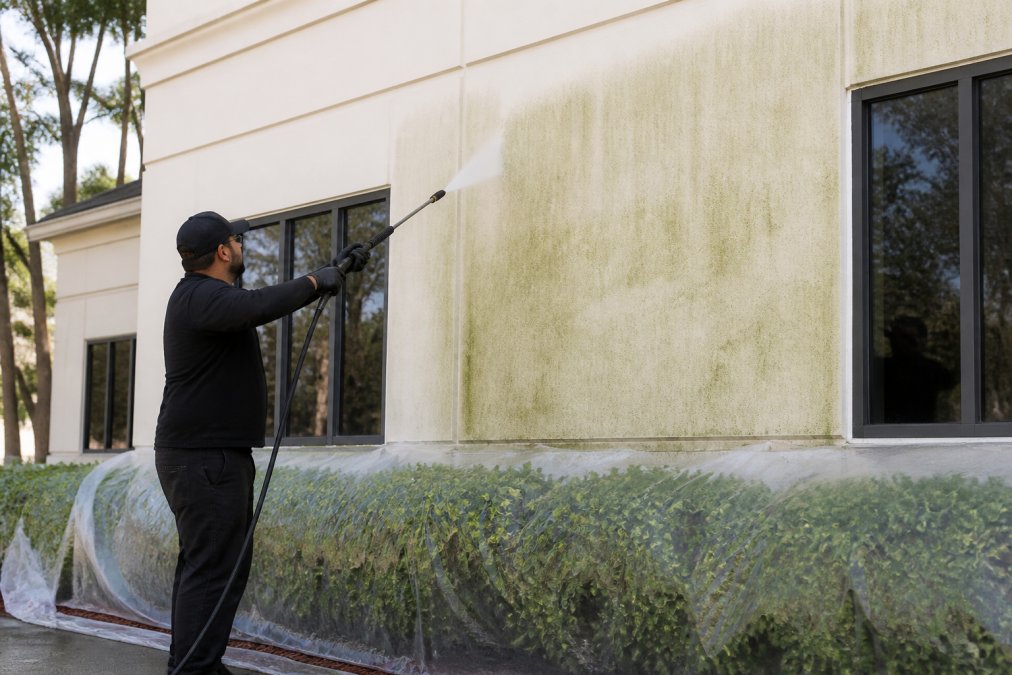
Application follows a bottom-up, rinse top-down pattern. Spray the cleaning solution from the lowest point upward so it does not streak, let it dwell for the manufacturer’s recommended time, then rinse from the top down. Low-pressure cleaning removes organic buildup without forcing water into seams.
Algae Removal, Mold Remediation, and Microbial Growth Control
Algae shows as green or black streaking, usually on the north-facing side of a building where moisture lingers. Mold remediation requires killing the organism, not just scrubbing the stain, or it returns within weeks. Microbial growth control depends on dwell time: the solution needs contact time to work.
- Apply in cooler conditions to prevent the solution drying too fast
- Never let cleaning agents dry on the surface
- Rinse all adjacent surfaces, including glass and metal
- Repeat treatment on severe growth rather than increasing pressure
Step 5: Follow OSHA Requirements for Exterior Building Maintenance
OSHA requirements for exterior building maintenance cover worker safety, not just cleaning quality. Any crew working at height, near electrical lines, or with chemical cleaning agents falls under general industry standards for fall protection, hazard communication, and personal protective equipment. But for a facility manager, worker safety is only half the compliance picture, the other half is environmental and contractual.
Worker-Safety Obligations
- Fall protection above the trigger height set by OSHA standards for fall protection, including guardrails, safety nets, or personal fall-arrest systems.
- Safety Data Sheets (SDS) on site for every cleaning agent used, and accessible to workers on every shift.
- Eye, skin, and respiratory protection matched to the chemistry, a diluted bleach mix calls for different PPE than a caustic degreaser.
- Proper labeling and secondary containment for all containers, including transfer buckets.
- Lockout/tagout procedures when cleaning near rooftop equipment or energized systems.
Environmental Compliance the Property Owner Inherits
Runoff from exterior cleaning is regulated under the Clean Water Act through the EPA’s MS4 program and, in many jurisdictions, state or local pretreatment rules. A facility manager who hires a contractor without asking about runoff controls can inherit liability for an illicit discharge, even when the contractor performed the work.
Questions worth asking before signing a contract:
- Where does wash water go on this property, storm sewer, sanitary sewer, or on-grade?
- Does the contractor use containment, recovery, or filtration when the discharge point is a storm sewer?
- Does the contractor carry general liability and pollution liability coverage, and can they produce a certificate of insurance naming the property owner as additional insured?
- Are workers covered by workers’ compensation, and is the contractor licensed in the state where the work occurs?
Contractor Verification Checklist
Hiring a licensed and insured contractor transfers much of this risk away from the property owner. Before work starts, collect:
- Certificate of insurance (general liability, workers’ comp, and pollution liability if wash water is recovered)
- State contractor license number, verified against the state licensing board
- Written safety plan covering fall protection, chemical handling, and heat-illness prevention
- SDS binder for every product the crew will use
- Discharge plan describing where wash water goes and how it is controlled
A certificate of insurance is not the same as verified coverage. Call the insurer to confirm the policy is active and that the scope of work is covered. Certificates are easy to forge and easy to let lapse.
Step 6: Use a Commercial Building Facade Maintenance Checklist
A written checklist turns exterior cleaning from a one-time event into preventative maintenance. Use this as your working template:
- Walk the property and photograph all surfaces before cleaning
- Identify each substrate and note fragile areas
- Confirm sealant integrity around windows and joints
- Check weather forecast and wind conditions
- Pre-wet and cover landscaping
- Mix cleaning agents to the correct dilution ratio
- Apply bottom-up, dwell, then rinse top-down
- Inspect for missed organic buildup
- Rinse all adjacent surfaces and landscaping
- Photograph results and log the date for the next cycle
Most commercial properties benefit from professional cleaning once or twice a year, with high-traffic entryways and shaded facades needing more frequent attention. That schedule protects asset protection goals and keeps curb appeal consistent for tenants and customers.
The single biggest factor in how long a commercial exterior cleaning lasts is whether the organic growth was killed or just removed. Killing it at the root with proper dwell time keeps surfaces clean for months. Simply blasting the stain off brings it back in weeks.
Common Mistakes to Avoid in Safe Exterior Cleaning
Three mistakes cause most commercial exterior cleaning failures. First, using too much pressure on the wrong substrate, which strips paint and cracks stucco. Second, skipping the pre-wet on landscaping, which kills plants and creates liability. Third, cleaning in direct sun or high heat, which dries the solution before it can work and leaves streaks.
A fourth mistake is treating every surface the same. A building with stucco, anodized aluminum window frames, and a concrete plaza needs three different approaches in a single visit. Facility management teams that build this into their maintenance contracts avoid the surprise costs of surface damage and rework.
Conclusion
Commercial exterior cleaning is a technical job, and the wrong method creates damage that outweighs any cleaning benefit. Carters Precision Pressure Washing provides professional, high-quality cleaning services to help commercial properties in Los Angeles shine. We specialize in expert pressure washing for various exterior surfaces to restore their appearance and cleanliness. Our team is dedicated to delivering top-tier results that enhance your property’s curb appeal. Contact us today to get a free estimate and experience our precision cleaning services.
Frequently Asked Questions
What are the safest methods for cleaning commercial building facades?
Soft washing with low pressure (under 500 PSI) and biodegradable cleaning agents is the safest method for most commercial facades. It removes organic buildup like algae and mold without damaging stucco, painted siding, or sealants. For tougher stains on concrete, pressure washing up to 3,000 PSI may be used, but always test a small area first. Following OSHA requirements for exterior building maintenance ensures worker and pedestrian safety.
How do you prevent damage when pressure washing commercial buildings?
Prevent damage by matching pressure to the substrate: use low pressure for soft materials like wood or stucco, and higher pressure only for concrete. Keep the nozzle at a 45-degree angle and at least 12 inches away. Pre-wet plants and cover them, and avoid spraying directly into windows, vents, or electrical fixtures. Always check for existing cracks or loose sealant before starting, and consider soft washing for delicate surfaces.
How often should commercial building exteriors be professionally cleaned?
Most commercial building exteriors need professional cleaning every 12 to 18 months, depending on local pollution, weather, and surrounding vegetation. High-traffic entryways and parking lots may require quarterly or monthly service. A regular commercial building facade maintenance checklist helps facility managers track when cleaning is due, preventing organic buildup and protecting curb appeal. In areas with heavy rain or tree cover, more frequent soft washing may be necessary.
What eco-friendly cleaning solutions are best for commercial exteriors?
Biodegradable surfactants and cleaning agents with low volatile organic compounds (VOCs) are best. Look for products that break down safely in water runoff and are safe for plants and pets when used as directed. Many professional soft washing solutions use sodium hypochlorite at low concentrations, which dissipates quickly. Always follow EPA guidelines for runoff and avoid using harsh acids on anodized aluminum or painted surfaces.