Table of Contents
- How Often Should You Clean Your Roof in Los Angeles?
- How Los Angeles Weather Affects Your Roof’s Cleaning Schedule
- Signs Your Roof Needs Cleaning: 7 Warning Signs to Watch For
- Cleaning Frequency by Roof Material: Asphalt, Tile, and More
- Safe Roof Cleaning Methods for Los Angeles Homes
- Pressure Washing Cost for Roof Cleaning: What to Expect
- How Roof Cleaning Protects Your Warranty and Home Value
- Your Seasonal Roof Maintenance Checklist
- Frequently Asked Questions
Last Updated: October 2, 2026
How Often Should You Clean Your Roof in Los Angeles?
If you own a home in Los Angeles, plan on cleaning your roof every 12 to 18 months. That holds for most asphalt shingle roofs in the region, but the full answer depends on where you live, a home near the coast faces different pressures than one in the Valley.
At Carters Precision Pressure Washing, we clean roofs across Los Angeles and see the same pattern: homes near the ocean grow algae faster, homes inland bake under stronger sun, and both need a schedule, just not the same one.
Below, we break down how often to clean your roof, the warning signs to watch for, and the methods that will not damage your shingles.
The Short Answer: Every 12 to 18 Months
Twelve to 18 months is the standard window for most Los Angeles roofs with asphalt shingles in a moderate climate zone.
But that window shifts based on a few factors:
- Coastal homes: Closer to every 12 months
- Inland homes: Closer to every 18 months
- Homes under trees: Every 12 months or sooner
- Homes with tile roofs: Every 18 to 24 months
The Asphalt Roofing Manufacturers Association maintenance guidance backs this range. It notes that regular cleaning protects shingles and extends roof life.
Think of it like changing your car’s oil. You can stretch it, but you pay for it later.
How Los Angeles Weather Affects Your Roof’s Cleaning Schedule
Los Angeles weather is several micro-climates packed into one county, and each puts a different pressure on your roof.
Treating the whole region as one climate zone is the most common mistake homeowners make. A roof in Santa Monica and one in Woodland Hills can be 20 miles apart and need completely different schedules.
Coastal Humidity and the Marine Layer
Homes within a few miles of the ocean sit under the marine layer, cool, moist air that rolls in most mornings and often does not burn off until midday.
The marine layer also slows evaporation after rain, so water sits in tile gaps and shingle valleys longer than inland.
For coastal humidity, clean your roof closer to every 12 months.
Inland Heat, UV Damage, and the Valley Micro-Climate
Inland areas face the opposite problem. Strong sun and heat break down shingle granules through roof oxidation: the asphalt binder dries out, granules loosen, and the surface becomes brittle.
Inland valleys, the San Fernando, San Gabriel, and Santa Clarita valleys, routinely see summer temperatures above 100°F.
Clean inland roofs every 18 months to remove baked-on grime and check for UV wear.
Santa Ana Winds and Wildfire Ash
From roughly October through March, Santa Ana winds push dry, hot desert air toward the coast, carrying fine dust, pollen, and, during wildfire season, ash.
Homes in the foothills and wind corridors, the Santa Clarita Valley, Inland Empire edges, and San Gabriel foothills, often need a post-wind-season cleaning even off schedule.
Shade, Trees, and the North-Slope Problem
Tree cover is its own micro-climate. A roof under a mature oak or pine stays damp longer, collects leaf litter year-round, and rarely gets drying sun.
North-facing slopes are the same story in miniature: less sun, longer damp, algae and moss first. If you inspect only one part of your roof, inspect the north slope.
Putting the Micro-Climates Together
A practical way to set your schedule is to start with the 12-to-18-month baseline and then adjust:
- Within 3 miles of the coast: subtract 3 to 6 months
- Above the fog line in the hills: subtract 3 to 6 months
- Inland valley with full sun: keep the baseline, lean toward 18 months
- Under mature trees: subtract 3 to 6 months and add a fall debris clearing
- In a Santa Ana wind corridor: add one post-wind-season inspection each year
No single number fits every roof in the county. The homeowners who get the longest roof life match the schedule to the block they live on, not the city on their mailing address.
Signs Your Roof Needs Cleaning: 7 Warning Signs to Watch For
Your roof tells you when it needs attention. Look for these seven signs.
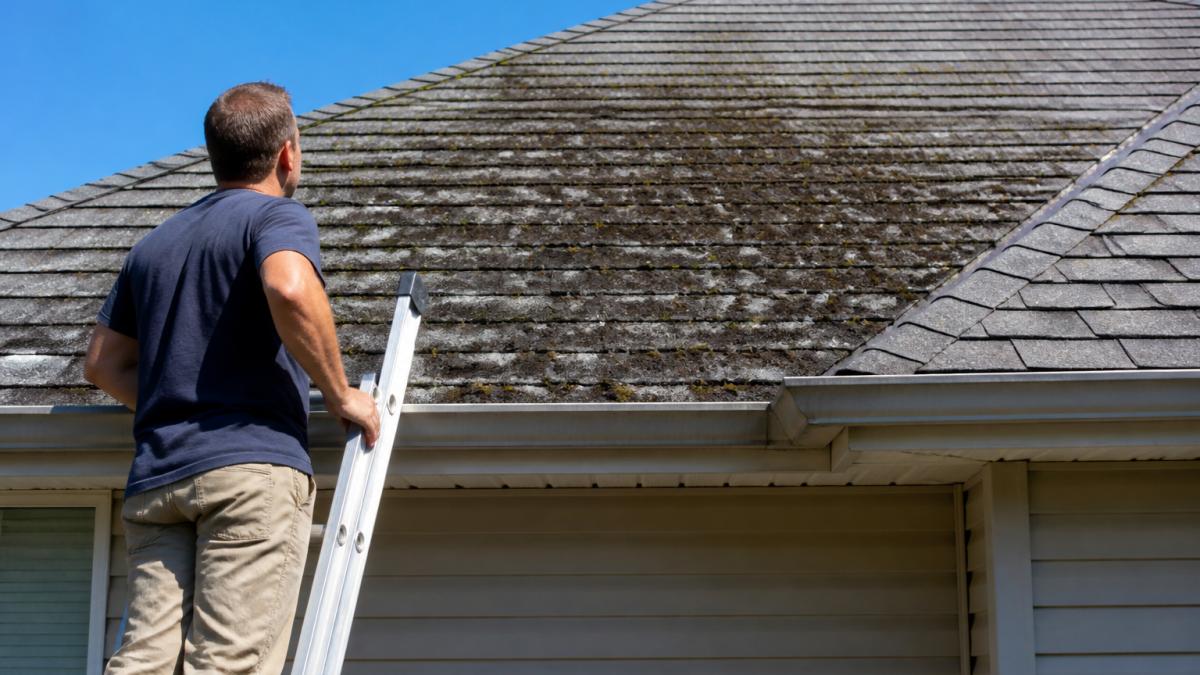
- Dark streaks: Black or green stains, usually algae growth
- Moss patches: Green clumps, common on shaded or north-facing slopes
- Granule loss: Piles of grit in your gutters
- Clogged gutters: Debris backing up water onto the roof
- Stained siding: Streaks running down your exterior walls
- Visible debris: Leaves, twigs, or dirt piled on the surface
- Higher cooling bills: A dirty roof reflects less heat
If you spot two or more of these, it is time to act. Waiting lets the damage spread.
Cleaning Frequency by Roof Material: Asphalt, Tile, and More
Your roof material sets the baseline schedule. Here is how the main types compare.
| Roof Material | Cleaning Frequency | Main Threat |
|---|---|---|
| Asphalt shingles | 12-18 months | Algae, moss, granule loss |
| Clay tiles | 18-24 months | Moss, debris in gaps |
| Concrete tiles | 18-24 months | Algae, dirt buildup |
| Cool roofs / TPO | 12-18 months | Dirt, loss of reflectivity |
Asphalt Shingles
Asphalt shingles are the most common roof in Los Angeles. They need cleaning every 12 to 18 months. Algae growth is the biggest threat. It eats into the shingle surface and shortens roof lifespan.
Clay and Concrete Tiles
Clay and concrete tiles last longer, so they can go 18 to 24 months between cleanings. Moss and debris settle in the gaps, trapping moisture that can crack tiles in a freeze.
Cool Roofs and TPO Membranes
Cool roofs and TPO membranes are designed to reflect heat. Dirt blocks that reflectivity, so they need cleaning every 12 to 18 months. A dirty cool roof cannot do its job.
Safe Roof Cleaning Methods for Los Angeles Homes
The method matters as much as the schedule. The wrong approach can strip granules and void your warranty.
Soft Washing vs. Pressure Washing
Soft washing uses low pressure and cleaning solutions to remove growth; pressure washing uses high pressure to blast dirt away.
For roofs, soft washing is the safe choice. High pressure can strip shingle granules, crack tiles, and force water under the roof. Hiring a crew that pressure washes every surface the same way is a recipe for damage.
Eco-Friendly Cleaning Agents
Many homeowners worry about harsh chemicals hurting plants and pets. That concern is fair.
Eco-friendly cleaning agents break down safely and target algae and moss without harming your yard. Ask any provider what they use before they start. A good crew will explain their mix and protect your landscaping.
Pressure Washing Cost for Roof Cleaning: What to Expect
Roof cleaning pricing depends on several factors. There is no single flat rate.
What drives the price:
- Roof size: Larger roofs take more time and solution
- Roof pitch: Steeper roofs need more safety setup
- Growth level: Heavy algae or moss takes longer to treat
- Access: Tight lots and tall homes add complexity
Because of this, most providers quote per job, not per square foot. Be wary of any quote given without seeing your roof first.
For a free estimate on your specific roof, reach out to Carters Precision Pressure Washing. We assess your roof and give you a clear number.
Never accept a roof cleaning quote given over the phone without an inspection. A price set without seeing your roof often leads to surprise fees or rushed, damaging work.
How Roof Cleaning Protects Your Warranty and Home Value
A clean roof is not just about looks. It protects your wallet in two ways, and the warranty side is where most homeowners get surprised.
How Cleaning Can Void a Manufacturer Warranty
Most asphalt shingle manufacturers, including the major brands covering most homes in the region, write maintenance and installation requirements directly into their warranties. Those warranties typically cover manufacturing defects, not homeowner- or contractor-caused damage, and that distinction matters.
The mechanism is straightforward. If a cleaning method damages the roof, the manufacturer can attribute the failure to that damage rather than to a defect, and deny the claim. The two methods that most often trigger denials are:
- High-pressure washing. Pressure washing strips the protective granules off asphalt shingles. Once granules are gone, the shingle is exposed and fails early. Manufacturers treat granule loss from pressure washing as homeowner-caused damage, not a defect.
- Harsh or improper chemicals. Some cleaning solutions can degrade the asphalt binder, dry out sealants, or stain tile and metal surfaces. If the wrong product is used, the resulting damage is on you, not the manufacturer.
There is also a paperwork side. Many warranties require that the roof be maintained in accordance with the manufacturer’s published guidelines, and some require proof of professional installation and maintenance if a claim is filed. Keeping a simple record, date of each cleaning, method used, and who did the work, gives you something to point to if a claim ever comes up. The Federal Trade Commission guidance on warranty coverage explains how maintenance terms work in written warranties and what a manufacturer can and cannot require.
What a Warranty-Safe Cleaning Looks Like
A cleaning that protects your coverage has three features:
- Low pressure. Soft washing uses low pressure and a cleaning solution to remove growth, rather than blasting it off. This is the method most manufacturers and roofing associations consider acceptable for asphalt shingles.
- Approved cleaning agents. Ask what the crew uses and whether it is compatible with your roof material. A reputable provider will tell you without hesitation.
- No walking on fragile areas. On tile roofs, foot traffic is the leading cause of cracked tiles. A crew that knows tile will use boards or stay on the valleys rather than walk the field of the roof.
If a provider cannot explain their method in those terms, that is a signal to keep looking.
The Home Value Side
Curb appeal drives first impressions, and the roof is one of the first things a buyer sees. Black algae streaks tell buyers the home was neglected, and buyers price neglect into their offers. A clean roof signals a well-kept property and removes an easy objection.
For sellers, the timing matters. Schedule your roof cleaning at least a month before listing. That gives you time to fix anything the cleaning reveals, loose flashing, worn pipe boots, cracked tiles, before showings start, rather than scrambling after an inspection report comes back.
Keep a simple roof file: the date of each cleaning, the method used, the name of the provider, and any photos. If you ever file a warranty claim or sell the home, that record is worth more than you would expect.
Never let a crew pressure wash an asphalt shingle roof. It strips granules, shortens the roof’s life, and gives the manufacturer a reason to deny a future claim. Soft washing is the standard for a reason.
Your Seasonal Roof Maintenance Checklist
Run through this checklist twice a year, in spring and fall.
- Inspect the roof for dark streaks and moss
- Clear leaves and debris from the surface
- Clean gutters and downspouts
- Check for loose or missing shingles
- Look for granule buildup in gutters
- Trim tree branches away from the roof
- Check attic for leaks or moisture
- Schedule professional cleaning if needed
A little upkeep goes a long way. Catch small issues before they become big bills.
Frequently Asked Questions
How much does it cost to have a roof cleaned in Los Angeles?
The cost to clean a roof in Los Angeles depends on the size of your home, the type of roofing material, and the level of buildup. Pressure washing cost for roof cleaning typically reflects the labor and specialized equipment needed for safe soft washing. Because pricing varies, it is best to request a free estimate from a local professional like Carters Precision Pressure Washing to get an accurate quote for your specific property.
What is the 25% rule for roofing?
The 25% rule is a guideline used by some roofing professionals and insurers. It suggests that if more than 25% of a roof is damaged or needs repair, it may be more cost-effective to replace the entire roof rather than patch it. While not a universal building code, it is a common industry standard. Regular cleaning helps you avoid reaching that threshold by preventing small issues like moss accumulation from turning into structural damage.
Is pressure washing safe for all types of roofing materials?
No, high-pressure washing is not safe for all roofs. It can strip shingle granules, crack clay tiles, and force water under flashing. Safe roof cleaning methods for Los Angeles homes usually involve soft washing, which uses low pressure and specialized cleaning solutions to kill algae and mold at the root. Always confirm that your provider uses soft washing techniques for asphalt shingles and tiles.
Does roof cleaning prevent mold and algae growth?
Yes, professional roof cleaning removes the organic matter that mold and algae feed on. In Los Angeles, coastal humidity and marine layer moisture create ideal conditions for biological growth. Cleaning your roof every 12 to 18 months, combined with a preventative treatment, stops algae from spreading and keeps your roof looking new. This also helps maintain your home’s curb appeal and can extend the roof’s lifespan.
Roof maintenance can feel like one more chore on a long list. But the cost of neglect is far higher than the cost of care. Carters Precision Pressure Washing offers expert soft washing for roofs, houses, and exterior surfaces across Los Angeles. Our team restores curb appeal and protects your roof without harsh pressure that causes damage. Get started with Carters Precision Pressure Washing and see your property shine again. Call for a free estimate today.