Table of Contents
- Why Eco Friendly Exterior Home Cleaning Matters for Curb Appeal
- Soft Washing vs Pressure Washing Environmental Impact
- Safe Exterior Cleaning for Plants and Pets
- How to Remove Algae from Wood Decks Without Harsh Chemicals
- DIY Eco Friendly Cleaning Recipes with White Vinegar and Baking Soda
- Surface-by-Surface Guide: Siding, Roofs, Driveways, and Patios
- What to Ignore: Common Eco Cleaning Myths and Bad Advice
- Frequently Asked Questions
Last Updated: September 18, 2026
Why Eco Friendly Exterior Home Cleaning Matters for Curb Appeal
Eco friendly exterior home cleaning removes dirt, mold, algae, and stains from siding, roofs, and hardscapes using biodegradable, plant-based products and low-pressure methods instead of harsh chemicals and high-pressure blasting. For Los Angeles homeowners, it solves two problems at once: a house that photographs well for buyers, and a yard that stays safe for kids, pets, and landscaping.
Here’s the part most guides skip. Traditional pressure washing doesn’t just risk your siding, it sends a slurry of bleach, surfactants, and dislodged grime into storm drains that feed directly into the ocean. That runoff is a real problem in coastal watersheds, where EPA stormwater guidance on residential runoff notes that urban runoff is a leading source of water quality impairment.
The fix isn’t more pressure, it’s the right method, product, and surface-by-surface approach.
Soft Washing vs Pressure Washing Environmental Impact
Soft washing uses low pressure (under 500 PSI) with a cleaning solution to kill organic growth at the root. Pressure washing uses high pressure (2,000-4,000 PSI) with water alone to blast debris off a surface. The environmental difference comes down to runoff volume and chemistry: high-pressure washing pushes far more water across a surface, carrying mineral buildup, oxidized paint, and biological matter into soil and storm drains, while soft washing uses a fraction of the water and lets the cleaning agent do the work.
| Method | Pressure Range | Water Use | Best For | Runoff Risk |
|---|---|---|---|---|
| Soft washing | Under 500 PSI | Low | Roofs, siding, stucco, painted wood | Minimal |
| Pressure washing | 2,000-4,000 PSI | High | Concrete, pavers, brick | Higher |
| Hybrid | 500-1,500 PSI | Moderate | Decks, fences, mixed surfaces | Moderate |
A common mistake is assuming “eco friendly” means no cleaning agent at all. It doesn’t. It means the agent is biodegradable and applied at low pressure so it breaks down without harming soil biology or nearby plants.
Safe Exterior Cleaning for Plants and Pets
Safe exterior cleaning for plants and pets is really two separate problems: what the cleaning solution does to soil and foliage during the job, and what it leaves behind on the surface after the job. The mechanisms are different, so they need separate checklists.
What happens in the soil. Biodegradable surfactants and plant-derived cleaners break down through microbial action in soil, but that takes days, not minutes. During that window, concentrated product on root zones can pull moisture out of leaf tissue (osmotic burn) or shift topsoil pH enough to stress shallow-rooted plants like boxwood, hydrangea, and young turf. Chlorine bleach does the same thing faster and more violently, which is why bleach runoff causes the classic dead grass stripe along a driveway edge. The takeaway: dilution and dwell time matter more than the label, a plant-based cleaner at full strength, pooled at a shrub’s base, will still burn it.
What happens on the surface. Once a treated surface is dry and rinsed, residue is generally not a hazard for pets walking across it. What matters:
- Drying time, typically 1 to 4 hours depending on humidity, sun exposure, and surface porosity. Concrete and stucco hold moisture longer than vinyl or painted wood.
- Rinse discipline, a final low-pressure rinse of hardscape and adjacent turf flushes residual surfactant off the surface and into the soil profile where it can dilute.
- Porous surfaces, unsealed pavers, wood decks, and natural stone can hold trace residue longer than smooth siding. Give those an extra rinse and an extra drying cycle before letting pets back on.
Runoff is the part most guides skip. Cleaning solution that sheets off a driveway or roof follows the grade to the nearest storm drain, and in most municipalities storm drains discharge untreated into creeks, rivers, or coastal waters. That’s why many local stormwater programs ask residents to wash cars and clean hardscapes over grass or a gravel strip rather than the driveway apron, redirecting runoff onto a permeable surface lets soil biology break it down before anything reaches a drain.
A routine that actually protects the yard:
- Pre-soak landscaping with plain water so roots are hydrated before any product touches them
- Cover delicate plants with breathable tarps, not plastic, which traps heat and can scorch foliage underneath
- Keep pets indoors during application and until surfaces are fully dry, not just dry to the touch
- Rinse adjacent plants, turf, and hardscape thoroughly when the job is done
- Never let runoff pool near vegetable gardens or storm drain inlets
- On sloped properties, work top-down and use a berm or sandbag to divert flow away from drains
For pet owners, “pet safe” is a function of the specific product, dilution, and drying time, not a category.
“Biodegradable” describes what happens to a product over time in soil or water, it does not mean the product is safe to spray directly on ornamental plants, and it does not mean runoff is harmless if it reaches a storm drain before it breaks down.
How to Remove Algae from Wood Decks Without Harsh Chemicals
The best way to remove algae from wood decks without harsh chemicals is a low-pressure wash with an oxygen-based or plant-derived cleaner, a light rinse, and a re-sealing coat. Bleach shortens wood fiber life and leaves a gray, fuzzy surface; oxygen-based products lift growth without eating the wood.
Here’s the sequence that holds up:
- Clear furniture and sweep loose debris off the deck
- Wet the surrounding plants and grass
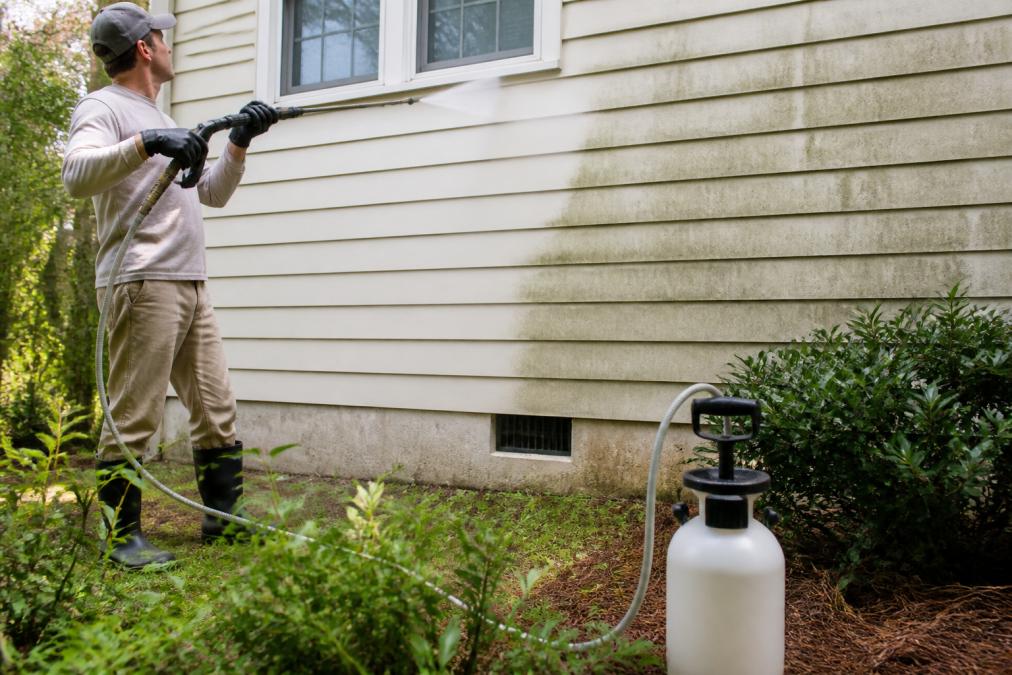
- Apply the cleaner at low pressure with a pump sprayer or soft-wash nozzle
- Let it dwell for the manufacturer’s recommended time
- Rinse with a fan-tip nozzle at low pressure, working with the grain
- Let the wood dry fully, then apply a sealer within a few dry days
Never use a turbo nozzle or a zero-degree tip on a wood deck. It gouges the grain, and once the surface is scarred, algae grows back faster in the grooves than it did before.
DIY Eco Friendly Cleaning Recipes with White Vinegar and Baking Soda
White vinegar and baking soda earn their reputation because the chemistry is real. Vinegar is roughly 5% acetic acid, which dissolves the mineral component of hard water spots and creates an environment where mildew spores struggle to re-establish. Baking soda is a mild abrasive and pH buffer, lifting stains without scratching and neutralizing acidic compounds in organic grime. Neither substitutes for a proper soft wash on a roof or heavily soiled stucco, knowing that boundary separates maintenance from wasted effort.
Recipes that hold up, with the caveats that matter:
- Mildew spray (hard surfaces): equal parts white vinegar and water in a spray bottle. Apply, let dwell 10 minutes, scrub with a soft-bristle brush, rinse. Works on painted siding, glass, and metal fixtures. Do not use on natural stone, the acid etches marble, travertine, and limestone.
- Concrete and grout paste: three parts baking soda to one part water. Spread on stains, let sit 15 minutes, scrub with a stiff brush, rinse. Good for rust blooms, tannin stains from leaves, and general grime. Not effective on oil, oil needs a surfactant-based degreaser.
- Deck brightener: one cup white vinegar per gallon of water. Apply to grayed wood, rinse after 15 minutes. This restores color but does not kill embedded algae, for that you need an oxygen-based cleaner, which releases oxygen bubbles that lift organic growth out of the wood grain without the fiber damage bleach causes.
- Glass and fixtures: equal parts vinegar and water, wipe with a microfiber cloth. Skip this on anodized aluminum and on any fixture with a factory coating, the acid dulls both over repeated use.
- Heavy mildew on painted wood: one cup oxygen-based cleaner (sodium percarbonate) per gallon of warm water. Apply, dwell 15 minutes, rinse at low pressure. This is the recipe most homeowners should reach for before vinegar on anything with visible black or green growth.
Vinegar and baking soda are excellent for routine maintenance and spot treatment. They are not a substitute for a soft wash on a roof, and they are not safe on every surface. Match the recipe to the substrate, respect the dwell time, and rinse thoroughly, that’s what separates a DIY job that works from one that damages the surface.
Surface-by-Surface Guide: Siding, Roofs, Driveways, and Patios
Every exterior surface has a different tolerance for pressure, chemistry, and dwell time. The biggest mistake homeowners make is treating them all the same.
Homeowners preparing a property for sale who need every surface cleaned correctly the first time, without risking damage to older siding, roofing, or landscaping.
What to Ignore: Common Eco Cleaning Myths and Bad Advice
Myth one: “If it’s green, it’s safe.” Plant-based cleaners still need proper dilution and rinsing, over-application burns foliage just like bleach.
Frequently Asked Questions
What is an eco-friendly house wash for exterior use?
An eco-friendly house wash uses biodegradable, plant-based solutions and low-pressure application instead of harsh chemicals. Soft washing with purified water and gentle detergents removes mold, mildew, and algae without damaging siding or harming nearby plants. Many professionals use EPA-approved products that break down safely in soil. For best results, schedule regular cleaning to prevent buildup and maintain curb appeal.
Is soft washing better for the environment than pressure washing?
Yes, soft washing typically has a lower environmental impact. It uses up to 60% less water than pressure washing and relies on biodegradable cleaning agents rather than sheer force. This reduces runoff and protects surface integrity. Pressure washing can strip paint, crack stucco, and send contaminants into storm drains. Soft washing is safer for landscaping and pets when done correctly.
How do I remove algae from wood decks without harming plants?
Mix one cup of white vinegar with a gallon of water and a few drops of mild dish soap. Apply with a pump sprayer, let it sit for 10 minutes, then scrub with a soft-bristle brush and rinse with low pressure. Avoid bleach, which can kill grass and shrubs. For stubborn algae, consider a professional soft wash service that uses plant-safe solutions.
What is the 5-5-5 rule for cleaning?
The 5-5-5 rule is a simple guideline for eco-friendly exterior cleaning: use 5 parts water, 5 parts white vinegar, and 5 drops of essential oil (like tea tree or lavender). This mixture effectively breaks down mildew and light stains on siding, decks, and patios. It is non-toxic, biodegradable, and safe for plants and pets when used as directed. Always test on a small area first.